DOGEPY · HOUSE RULES
Go-Stop deals, scoring and capture examples
Dogepy uses different deals in solo and online Go-Stop. Check the table mode as well as the player count.
Before you play
- Solo 2/3/4 players: 7/6/5 cards each, eight field cards, three-point threshold. Online two-player: ten each, eight field, seven points. Online three-player: seven each, six field, three points.
- The deck has 48 cards. No bonus cards, shaking, bombs, Pi/Gwang/Go-bak multipliers or month-9 animal-to-junk conversion.
- Match months. Choose between two matches; capture all three stacked matches with the fourth card.
- After Go, base points must exceed the previous Go score before another decision.
- One Go adds 1; two add 2; three multiply (base +2) by 2, four by 4, and so on. If hands run out without a Stop winner, the round is a draw.
Playing a hand
- Choose a matching card from your hand. Highlighting indicates a legal match, not necessarily the best move.
- Resolve the played card, then flip a stock card and resolve its match. Unmatched cards stay on the field.
- Inspect your opponents’ collected cards by category. Their unplayed hands remain hidden.
- At the threshold, Stop secures the win or Go continues the round at a risk.
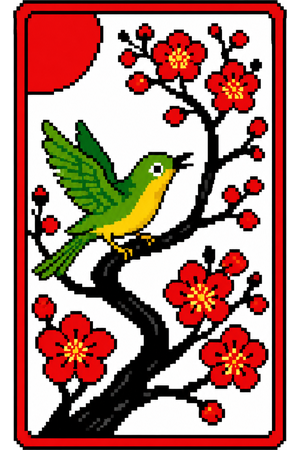
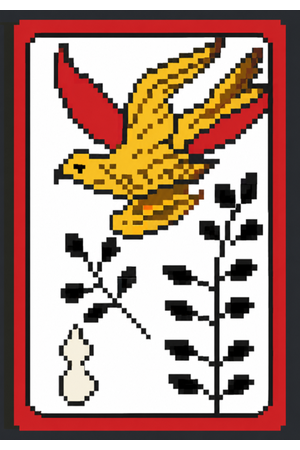
The three Godori birds

Score cards and combinations together
Three brights score 3 without rain or 2 with rain; four score 4 and five score 15. Five animals score 1, plus 1 for each additional animal. Godori—bird animals from months 2, 4 and 8—adds 5.
Five ribbons score 1 plus 1 per extra ribbon. Red poetry ribbons (1,2,3), blue ribbons (6,9,10) and grass ribbons (4,5,7) each add 3. Ten junk units score 1 plus 1 per extra unit; double-junk cards from months 11 and 12 count as two units.
Five animals including Godori score 6: five for Godori and one for the animal count. Eleven junk units add two, giving eight base points.
Choose the useful match
Suppose the field has a month-2 animal and month-2 junk and you play its ribbon. If you already own the month-4 and month-8 birds, taking the animal completes Godori. With nine junk units and no near-complete Godori, the junk card can instead reach ten units.
Inspect opponents’ collections too. You cannot see the next stock card, so a useful plan is not a guaranteed winning move.
Ppeok, Jjok, Ttadak and field clears
Matching one field card and then flipping the same month creates Ppeok: all three remain on the field. The fourth card can later collect that stack.
Playing an unmatched card and flipping its partner creates Jjok. Matching two existing field cards with your played card and stock card creates Ttadak. Emptying the field creates a sweep. These events can trigger junk transfers.
Transfers use a shared count in seat order, not one card from every opponent. Ordinary junk is taken before double-junk. No junk can be taken from an empty collection. A transferred double-junk card still counts as two units.
After calling Go
At a three-point table, Go at three requires reaching at least four base points for another decision. Stop at four with one Go for five final points. Online two-player tables use seven as the initial threshold.
Eight base points with two Go gives ten final points; eight with three Go gives twenty. Go bonuses do not themselves satisfy the next base-score increase. If another player stops first, they win.
Solo winning scores include Go bonuses. Multiplayer results use the game’s separate win/loss record. No scores can be exchanged for cash or vouchers.
Rules checked: 2026-10-23. These describe Dogepy’s implementation, which may differ from other tables.
Return to the game →